
NATIONAL GOVERNMENT
Scaling water reform throughdeployable capability.
Safe water, functioning infrastructure, regulatory compliance, and public health outcomes are all visible measures of state capacity. When water systems fail, the consequences extend far beyond engineering — disease outbreaks, economic disruption, political fallout, and loss of public trust.
Through Kalabas, our goal is to help government address these realities at a national scale — offering a mechanism to move beyond policy intent toward a repeatable, deployable water infrastructure platform that delivers measurable outcomes.

Standardised national solution
A repeatable, modular treatment system deployable across municipalities with consistent outcomes.
Rapid deployment
Months to operation, not years — enabling decisive action during public health and service delivery crises.
Lower lifecycle cost
Reduced capital, energy, and chemical requirements improve affordability and long-term sustainability.
Local manufacturing, global relevance
South African engineering and production that builds domestic capability and export potential.
A national context
South Africa's water infrastructure landscape reflects decades of growth, shifting demand, and increasing pressure on existing systems. Ageing treatment works, uneven municipal capacity, skills constraints, and stressed wastewater networks have elevated water security to a national priority.
The fiscal constraint
Large, capital-intensive megaprojects are difficult to deliver at scale — particularly when solutions need to be rolled out across hundreds of municipalities with different starting points, capabilities, and timelines. This has sharpened the focus on approaches that are faster to deploy, easier to replicate, and more predictable in cost and performance.

From bespoke projects to a national delivery platform
Rather than treating each failing water system as a one-off engineering problem, Kalabas introduces a standardised, modular potable water solution that can be deployed repeatedly across the country.
Standardisation ensures consistent performance, predictable costs, and faster rollout — creating the foundation for a national water product, not just isolated interventions."
Crisis response that delivers visible results
In emergency contexts, speed is not optional. Traditional infrastructure responses often take years — timelines that are incompatible with public health crises and political accountability.
~10 mo
Contract to first water
50 MLD
Delivered at Hammanskraal
4–6 yr
Conventional equivalent
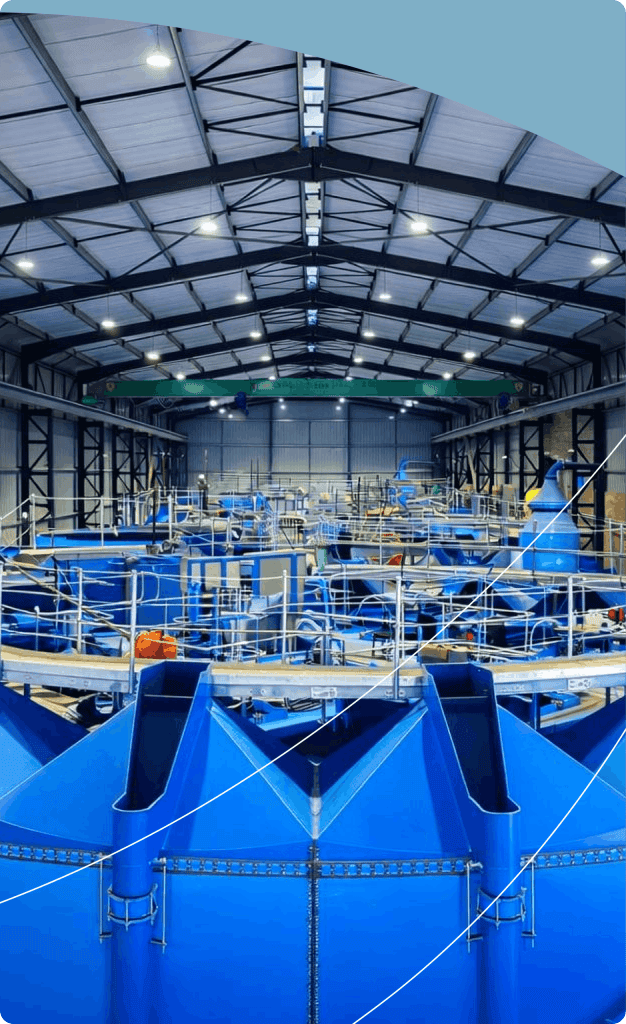
Kalabas has demonstrated the ability to restore safe drinking water in months rather than years. In Hammanskraal, deployment occurred during an active cholera outbreak, with first water delivered within roughly ten months of contract award.

Fiscal discipline across the infrastructure lifecycle
Beyond speed, Kalabas reduces the long-term cost of water infrastructure. Its integrated design lowers energy consumption, chemical usage, and operational complexity compared to conventional plants. The elimination of large dedicated sedimentation tanks alone can save tens of millions of rands per unit.
Lower CAPEX and OPEX let government demonstrate responsible stewardship of public funds while extending infrastructure reach further than traditional approaches would allow.
Aligning delivery with national and global commitments
Kalabas supports government's ability to meet key development and sustainability objectives without relying on multibillion-rand megaprojects.
SDG 6
Clean water and sanitation
Direct contribution through rapid, reliable potable water delivery at scale.
SDG 9
Industry, innovation and infrastructure
Locally engineered, world-first modular water technology.
SDG 13
Climate action
Lower energy, reduced chemical dependency, resilience to climate-driven variability.
Building domestic capability and economic value
Kalabas is fully engineered and manufactured in South Africa. Its rollout supports local manufacturing, skills development, and job creation — embedding economic value within the infrastructure itself rather than exporting it through imported systems.
As a world-first innovation developed locally, it also positions South Africa as a source of export-ready water technology, extending impact beyond domestic borders.
A partnership model that can be replicated
The Hammanskraal deployment demonstrated a collaborative delivery model involving water boards, engineering firms, municipalities, and national departments. This framework provides government with a replicable approach to implementation — reducing coordination friction while maintaining accountability across institutions.
Magalies Water Board
Pro-Plan Consulting Engineers
Dept of Water and Sanitation
City of Tshwane
National Government
"A replicable approach to implementation — reducing coordination friction while maintaining accountability across institutions."